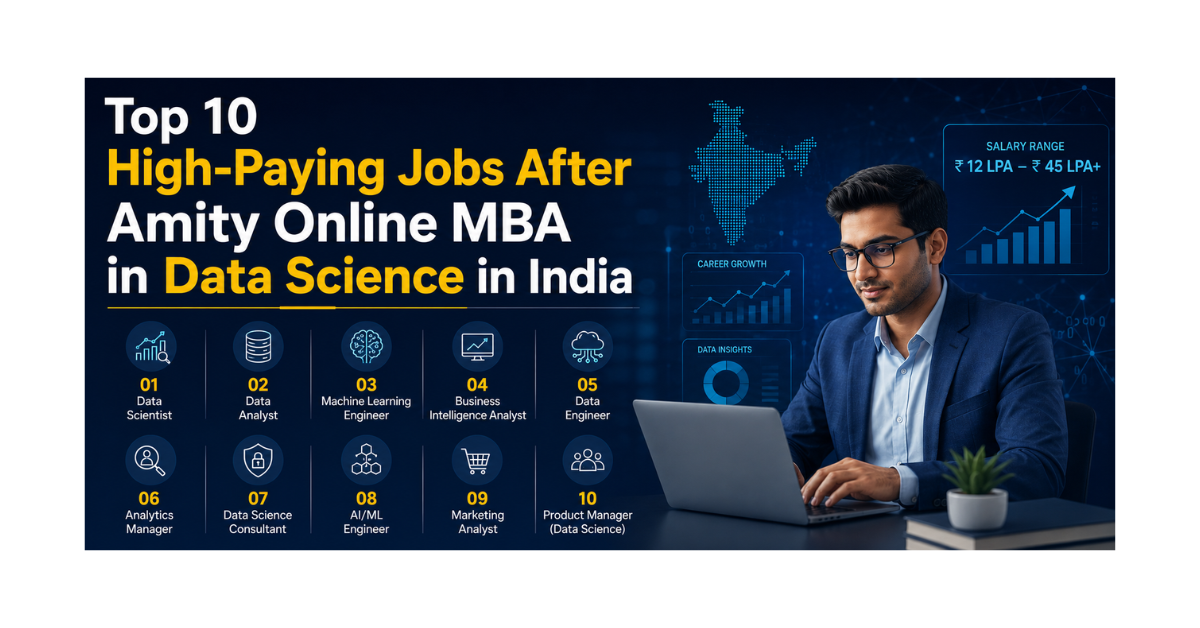
Top 10 High-Paying Jobs After Amity Online MBA in Data Science in India
Let us talk about something most career guides skip over. The Indian job market in 2024 is not short of data science graduates. Engineering colleges, bootcamps, and online platforms have produced thousands of people who know Python and can build a regression model. What the market genuinely lacks is professionals who understand data deeply AND can walk into a boardroom and turn that data into a business decision worth crores of rupees.
That specific gap is exactly what an Amity Online MBA in Data Science is built to fill. And that gap is where the serious money lives.
Get Free Counseling
This article covers the ten highest-paying career paths available to graduates of this program, along with realistic salary figures, sector-specific demand, and honest advice on how to actually break into these roles.
Why the Amity Online MBA in Data Science Carries Real Weight
Before getting to the jobs themselves, it is worth spending a moment on why this particular program matters to employers. India has no shortage of MBA colleges offering data or analytics specializations. But Amity University carries specific credibility markers that make a real difference on a resume.
What the Curriculum Actually Covers
The Amity Online MBA in Data Science is not a regular MBA with a Python elective tacked on. The program runs across four semesters and covers machine learning, deep learning, natural language processing, business analytics, and statistical modeling alongside core MBA subjects like financial management, marketing strategy, and organizational behavior.
What this means practically is that graduates leave the program able to do two things that most professionals struggle to combine: they can build and interpret predictive models, and they can explain the business impact of those models to a CFO or a board of directors. That combination is rare and it commands a premium in the job market.
Accreditation and Industry Standing
Amity University holds a NAAC A+ grade, and its online programs are approved by the University Grants Commission. This matters because a significant number of government-owned enterprises and large private sector firms have formal eligibility criteria that require UGC-recognized degrees.
The university also maintains active recruitment partnerships with companies like TCS, Wipro, Infosys, Deloitte, and Amazon India. For online MBA students specifically, Amity provides career development services including mock interviews, resume clinics, and referrals to its placement network, which covers over 150 companies across sectors.
The Real State of Data Science Hiring in India Right Now
India is short on data talent by a margin that surprises most people. According to the Analytics India Magazine Salary Study 2023, India had over 97,000 open data science and analytics roles that went unfilled during the year. The International Data Corporation projects that by 2026, India will need over 11 million data professionals, while current supply sits at roughly 4 million.
The salary impact of this shortage is very real. Between 2021 and 2023, median data science salaries in India grew by approximately 23%, outpacing most other professional sectors. In fintech and e-commerce specifically, mid-level data professionals saw 30% to 40% year-on-year salary increases as companies competed aggressively for talent.
Here is the piece that most people miss: pure technical talent is only one dimension of the shortage. The deeper shortage is in professionals who combine data science skills with business strategy, people management, and executive communication. MBA programs in data science exist specifically to produce these hybrid professionals, and the salary differential between a pure data scientist and a data science MBA in a leadership track can be as high as 60% to 80% at the five-year mark.
Top 10 High-Paying Jobs After Amity Online MBA in Data Science
1. Data Scientist
A data scientist builds statistical and machine learning models to extract patterns from large datasets and translate those patterns into insights that drive business decisions. With an MBA, this role takes on a different dimension. You are not just building models, you are contextualizing them within business goals, communicating findings to non-technical stakeholders, and often owning the roadmap for what questions the data team should be answering next.
Companies hiring actively for data scientists with an MBA background in India include Razorpay, PhonePe, HDFC Bank's analytics division, Flipkart, and Accenture AI. Salary ranges in 2024 sit between Rs. 12 LPA and Rs. 28 LPA at the mid-level, with senior scientists at product companies crossing Rs. 40 LPA.
The MBA also gives you an edge during salary negotiations. Most data scientists negotiate purely on technical skills. An MBA holder can also negotiate on business impact delivered, which is a much stronger position.
2. Chief Data Officer
The Chief Data Officer is a C-suite executive responsible for an organization's entire data strategy. This includes governance of data assets, building analytics and AI infrastructure, ensuring regulatory compliance around data usage, and aligning the data function with overall business objectives.
This is not an entry-level destination. Most CDOs in India have 12 to 18 years of experience. But it is important to map this role from day one because the career decisions you make in your first five years after your MBA either set you up for the the CDO path or lead you in a different career direction. Professionals targeting this role should actively seek cross-functional experience across analytics, engineering, and product or strategy early in their careers.
CDO salaries in India range widely based on company size. At mid-size firms, the range is Rs. 45 LPA to Rs. 70 LPA. At large banks and technology companies, total compensation including stock options can cross Rs. 1.5 crore per annum.
3. Machine Learning Engineer
Machine learning engineers take the models that data scientists design and build the production systems that deploy and maintain them at scale. The role requires strong software engineering skills alongside solid understanding of ML algorithms, cloud infrastructure, and data pipeline design.
With an MBA, you add a layer of value that pure engineers often lack. You can manage a team of engineers and scientists, communicate technical constraints clearly to product managers and business leaders, and make resource allocation decisions that balance technical quality with business timelines.
In India, ML engineer roles are concentrated in Bangalore, Hyderabad, and Mumbai. Companies like Google India, Microsoft, Nvidia, Meesho, and Swiggy pay between Rs. 18 LPA and Rs. 40 LPA for mid-to-senior ML engineering roles. At large US-headquartered tech firms operating in India, the ceiling is higher.
4. Business Intelligence Manager
A BI Manager designs and maintains the reporting and visualization infrastructure that allows business teams to monitor performance, identify trends, and make informed decisions. The core tools are Power BI, Tableau, Looker, and increasingly cloud-native BI platforms like Google Looker Studio and AWS QuickSight.
What makes this role particularly well-suited to an MBA graduate is that it sits at the intersection of technical work and business communication. You are responsible for making complex data accessible to people who have no analytical background, which requires as much skill in simplifying and storytelling as it does in building dashboards.
BI Manager roles in India pay between Rs. 14 LPA and Rs. 28 LPA at the manager level. At large MNCs in sectors like FMCG, banking, and retail, total compensation packages including bonuses can push this significantly higher.
5. Data Analytics Manager
A Data Analytics Manager leads a team of analysts and oversees the analytical output across one or more business functions. This could mean managing an analytics team within a marketing department at a consumer goods company, or leading the risk analytics function at a bank.
The MBA component is essential for this role. You need to understand how to set KPIs that are aligned with business strategy, prioritize analytical projects based on ROI, and manage a diverse team of people with different technical skill levels. The data science background is equally essential because you need the technical credibility to earn the respect of your team and the ability to review their work meaningfully.
Salaries for Analytics Managers in India range from Rs. 16 LPA to Rs. 32 LPA, with higher ranges at e-commerce, banking, and consulting firms.
Get Free Counseling
6. AI Product Manager
AI Product Managers define the vision, strategy, and development roadmap for products that are built on or powered by artificial intelligence. This is one of the fastest-growing and highest-paid roles in India's technology sector.
The role demands a genuinely rare combination of skills: deep understanding of how AI models work, strong product thinking, business strategy capabilities, and the communication skills to align engineering teams, data scientists, business stakeholders, and customers around a shared product vision.
An Amity Data Science MBA builds almost all of the raw material for this role. What you add through work experience is product intuition and an understanding of user behavior. AI Product Manager roles in India pay between Rs. 20 LPA and Rs. 45 LPA, with equity compensation at startups potentially making this the highest-paying entry on this list.
7. Quantitative Analyst
Quantitative analysts, known in the industry as quants, use mathematical models and statistical techniques to analyze financial instruments, price derivatives, assess risk, and inform trading strategies. This role is dominant in investment banking, hedge funds, insurance companies, and asset management firms.
Mumbai is the center of gravity for quant roles in India, though Bangalore and Pune also have active hiring from fintech companies and global capability centers of foreign banks. Quant roles require strong statistical modeling skills, knowledge of financial markets, and increasingly, Python or R programming for model building and backtesting.
Mid-level quant roles pay between Rs. 20 LPA and Rs. 45 LPA. Senior quants at large investment banks can earn well beyond this, with all-in compensation including performance bonuses reaching Rs. 80 LPA to Rs. 1 crore in strong years.
8. Data Engineering Manager
Data engineers build the pipelines, infrastructure, and systems that make analytics and AI work possible. Without clean, reliable data pipelines, even the best data scientists and analysts cannot do their jobs effectively. A Data Engineering Manager leads this function, overseeing a team of engineers and ensuring the organization's data infrastructure is robust, scalable, and cost-efficient.
Managing a data engineering team requires technical knowledge of distributed systems, cloud platforms like AWS, GCP, or Azure, and tools like Apache Spark, Kafka, and Airflow. The MBA component adds team leadership, budget management, and vendor negotiation skills that are critical at the managerial level.
Data Engineering Managers in India earn between Rs. 20 LPA and Rs. 42 LPA, with the highest salaries at product companies with large data platforms like Razorpay, Juspay, and Groww.
9. Risk and Fraud Analytics Manager
As digital financial transactions in India have grown exponentially, so has the demand for professionals who can build systems to detect fraud, assess credit risk, and ensure regulatory compliance. India processed over 117 billion UPI transactions in 2023 alone, which gives you a sense of the scale of the fraud prevention challenge.
Get Free Counseling
Risk and Fraud Analytics Managers build and oversee the models that protect companies and customers from fraudulent activity. This requires deep expertise in anomaly detection, behavioral analytics, and regulatory frameworks like RBI guidelines on digital lending and KYC compliance.
The role sits at the intersection of data science, finance, and compliance, making it a natural fit for an MBA graduate with a data science background. Salaries range from Rs. 18 LPA to Rs. 42 LPA, with the highest packages at fintech companies, payments firms, and large private sector banks.
10. Analytics Consulting Manager
Management consulting firms with analytics practices are among the most aggressive recruiters of data science MBA graduates in India. Firms like Deloitte, McKinsey Analytics, BCG Gamma, KPMG, and EY Parthenon run analytics practices that advise large corporations on data strategy, AI adoption, and analytics capability building.
As a consulting manager, you lead client projects, manage engagement teams, develop proposals, and present findings to C-suite clients. The pace is demanding and the hours are long, but the compensation and the speed of career development are both exceptional.
MBA degrees are a near-prerequisite for reaching the manager level at these firms. Analytics Consulting Managers in India earn between Rs. 22 LPA and Rs. 55 LPA at the principal or senior manager level, with partner compensation significantly higher.
Skills Employers Actually Test You On
Knowing the job titles is useful. Knowing what hiring managers are actually testing in interviews is more useful.
Technical Skills That Hiring Managers Look For
Python is the baseline expectation across almost every data science and analytics role in India today. SQL is equally important and is tested rigorously in most interviews through case-based query problems. Machine learning fundamentals including regression, classification, clustering, and model evaluation are standard interview topics even for managerial roles.
For senior roles, knowledge of cloud platforms is increasingly mandatory. AWS and GCP certifications carry real weight in resume screening. Data visualization proficiency in Power BI or Tableau is tested at the BI and analytics manager level through hands-on assignments.
Business Skills That Separate Leaders from Analysts
Communication as a Career Multiplier
The ability to explain a complex model or analytical finding in simple, compelling language is tested at every level above analyst. Most companies use case study interviews for senior roles where you are expected to take a business problem, propose an analytical approach, and present findings clearly. Practicing this skill deliberately is one of the highest-return activities you can do during your MBA.
Financial Acumen in Data Roles
For roles in risk, consulting, or business intelligence, interviewers regularly test your understanding of financial statements, unit economics, and how analytical insights translate to revenue or cost impact. The MBA curriculum at Amity builds this foundation, and strengthening it through practice with real company financials pays dividends in interviews.
Which Sectors Pay the Most for This Profile in India
Not all industries price data science MBA talent equally. The highest-paying sectors in India for this profile, ranked broadly by salary levels:
Banking and Financial Services consistently tops the list for both salary and job stability. The data requirements in lending, risk, fraud, trading, and customer analytics are immense, and banks pay well for people who can manage these functions. Fintech sits just above traditional banking in many cases due to competitive equity compensation at growth-stage firms.
E-commerce and quick commerce companies like Amazon, Flipkart, Meesho, Zepto, and Blinkit invest heavily in data talent and compete aggressively on salary. IT and consulting firms offer strong structured career paths with international exposure. Healthcare and pharmaceuticals are a growing segment, with data roles in clinical analytics, supply chain optimization, and patient outcomes management expanding steadily. Telecom companies like Jio and Airtel run large in-house analytics teams that are consistently hiring.
Honest Salary Expectations at Every Career Stage
Here is a realistic picture of what compensation looks like across career stages for Amity Data Science MBA graduates in India, based on current market data:
At the entry level in the first two years, salaries range from Rs. 6 LPA to Rs. 12 LPA depending on prior work experience, technical skill depth, and the company. Fresh graduates joining mid-size IT firms or analytics startups will typically be at the lower end of this range. Those joining large BFSI firms or product companies with strong prior experience in data-adjacent roles can enter at the higher end.
Between the third and sixth year, as you move into senior analyst and junior manager roles, compensation typically sits between Rs. 15 LPA and Rs. 32 LPA. This is the stage where MBA graduates with strong performance records start to outpace non-MBA peers significantly.
From year seven to twelve, at senior manager and director level, compensation ranges from Rs. 32 LPA to Rs. 70 LPA. At this stage, company type and sector matter more than tenure in determining where you land within the range.
Get Free Counseling
At the executive level in CDO, VP, or partner tracks, total compensation can range from Rs. 70 LPA to well above Rs. 1 crore depending on company size, sector, and equity components.
Geography matters too. Bangalore, Mumbai, and Hyderabad offer premiums of 20% to 35% over equivalent roles in smaller cities.
Practical Steps to Land These Roles After Graduation
The degree is the starting point, not the finish line. Here is what actually moves the needle on job outcomes.
Build a visible portfolio during the MBA, not after. Work on public datasets, contribute to Kaggle competitions, and document two or three substantial projects on GitHub and LinkedIn. Hiring managers look at GitHub profiles as seriously as resumes for technical roles.
Network with purpose. Amity's alumni network spans multiple decades and thousands of professionals across India's top companies. A warm introduction from an alumnus who can speak to your work ethic is worth more than fifty cold applications.
Get one or two certifications that align with your target role. AWS Certified Machine Learning Specialty, Google Professional Data Engineer, and the Microsoft Azure AI Engineer certification are the three that hiring managers mention most often as differentiators. These signal that you invest in your skills beyond what the curriculum requires.
Be strategic about your first post-MBA move. If you are aiming for consulting, try to secure a data analyst role at a consulting firm even if it is below your target level. If you want to reach CDO, join a company where you can get exposure to data governance, strategy, and cross-functional analytics work early. The first two or three years after the MBA set a trajectory that is hard to change later.
Conclusion
An Amity Online MBA in Data Science puts you at the crossroads of two skill sets that India's economy is actively hungry for and not finding enough of. The ten roles covered in this article are not hypothetical opportunities. They are active job categories where companies are offering above-market compensation because the supply of qualified candidates is thin.
The salaries are real, the demand is real, and the path from the degree to these roles is achievable. What determines whether you reach the higher end of the salary ranges described here is not the degree itself. It is the quality of the portfolio you build during the program, the networks you cultivate, the certifications you add, and the clarity with which you target the sector and role that fits your background and goals.
The data science MBA is a genuinely powerful career investment in India's current economy. Use it well.
Frequently Asked Questions
1. Is the Amity Online MBA in Data Science recognized by the UGC? Yes. Amity University's online MBA programs are approved by the University Grants Commission of India, which means the degree meets eligibility requirements for both private sector roles and most public sector positions requiring an MBA.
2. What work experience is needed before joining this program? Amity accepts candidates with at least two years of post-graduation work experience for the MBA program. Candidates with backgrounds in IT, engineering, finance, or analytics typically find the transition into the curriculum smoother.
3. Can someone from a non-technical background complete this MBA? Yes. The curriculum is structured to build technical skills progressively. Students from commerce, economics, and business backgrounds regularly complete the program. Extra effort in the first semester on Python and statistics goes a long way.
4. How much does the Amity Online MBA in Data Science cost? Fee structures change periodically, so it is best to check directly on Amity's official admissions page. As of recent cycles, the total program fee for the online MBA has been in the range of Rs. 1.5 lakh to Rs. 2.5 lakh, which is significantly lower than full-time on-campus MBA programs.
5. Does Amity provide placement support for online MBA students? Yes. Amity Online provides career development services including resume workshops, mock interview sessions, and access to its corporate recruitment network for eligible online MBA students.
6. What is the difference between a Data Science MBA and a regular MBA? A regular MBA covers general business management across marketing, finance, operations, and strategy. A Data Science MBA integrates machine learning, statistical modeling, AI, and analytics into that core, producing graduates who can take on data leadership roles that a regular MBA graduate cannot.
7. Which city in India offers the most jobs for Data Science MBA graduates? Bangalore has the highest concentration of data science roles in India, driven by its technology sector ecosystem. Mumbai leads in finance and banking-related data roles. Hyderabad and Pune are strong secondary markets with growing demand.
8. Is the AI Product Manager role suitable for someone without prior product experience? Direct entry into AI PM roles from an MBA is possible but more likely with some prior experience in software product, analytics, or technology consulting. Most AI PMs in India move into the role from data science, software engineering, or product analyst backgrounds after gaining two to four years of experience.
9. How long does it typically take to reach a manager-level salary after this MBA? Most graduates with relevant prior experience reach manager-level roles and salaries within three to five years of completing the MBA. Those entering from pure technical backgrounds often move faster than those coming from unrelated fields.
10. Are certifications from AWS or Google necessary alongside this MBA? They are not required but they do make a measurable difference in hiring outcomes. In technical interviews and resume screening, cloud certifications from AWS, Google, or Microsoft signal practical capability that employers value highly.
11. What GPA or academic performance is expected during the program for good placement outcomes? Academic performance matters less than project quality and practical skill demonstration in most data science hiring processes. A strong capstone project, visible portfolio, and relevant internship or freelance work will outweigh grades in most technical interviews.
12. Can this MBA be completed while working a corporate job? Yes. The program is specifically designed for this. Lectures are available in recorded format, assessments are distributed across the semester, and live sessions are typically scheduled for evenings and weekends.
13. What is the scope of the Quantitative Analyst role outside of Mumbai? Most senior quant roles in India are concentrated in Mumbai. However, Bangalore and Pune have growing quant teams at fintech startups, global capability centers of foreign banks, and insurance analytics firms.
14. How competitive is the analytics consulting track for this profile? Very competitive at the top firms like McKinsey, BCG, and Deloitte. These firms conduct structured recruitment processes including case interviews and aptitude testing. Strong analytical thinking, communication skills, and demonstrated experience with data projects are key differentiators.
15. Is entrepreneurship a viable path after this MBA for someone interested in data science? Absolutely. The combination of technical data skills and business management training from the MBA creates a strong foundation for starting analytics consulting firms, data product startups, or AI-powered SaaS businesses. The Indian startup ecosystem has strong demand for data-driven products across health, finance, and agriculture.